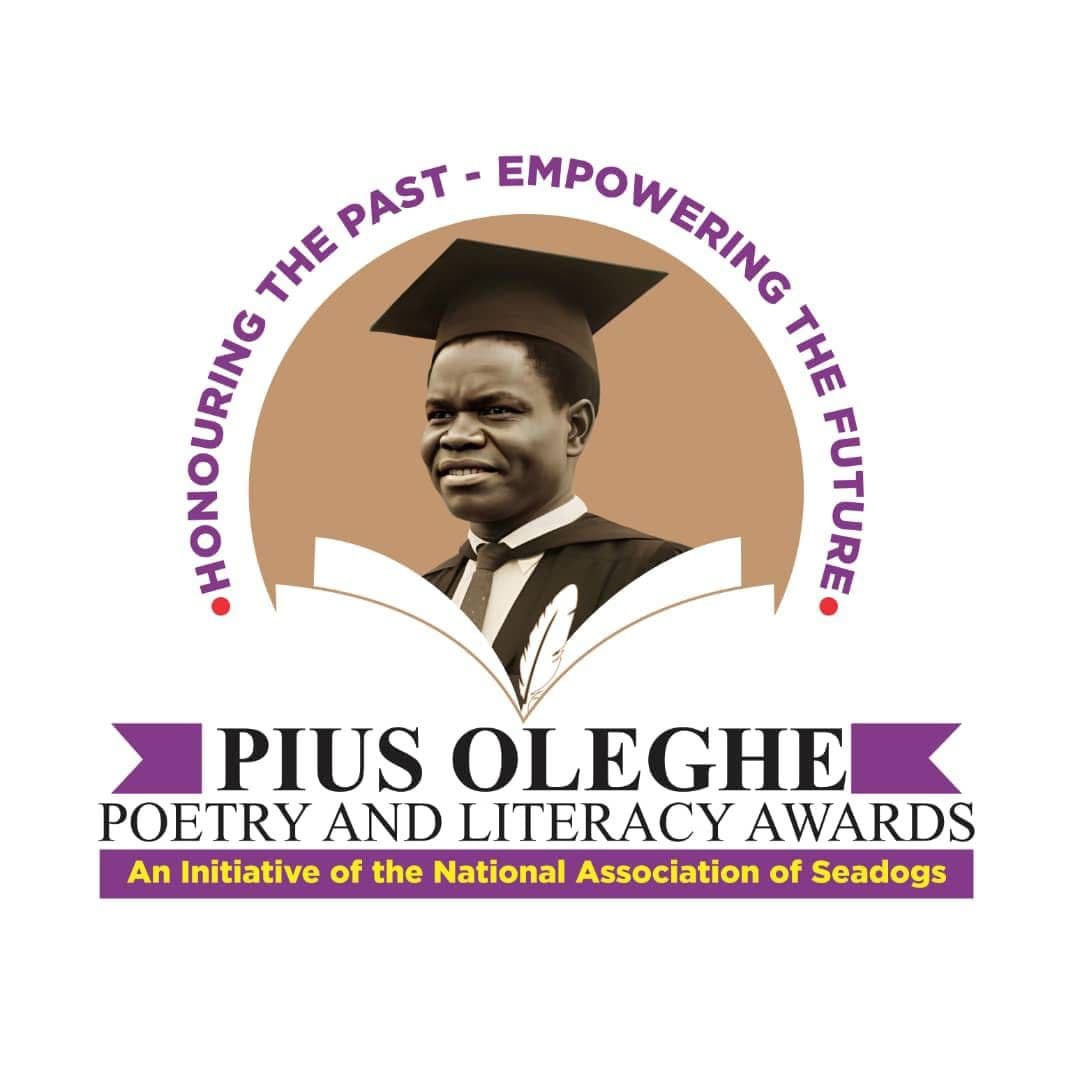
In a world where literary culture often thrives on spectacle occupied by big personalities, loud opinions, louder controversies, and the constant pressure to establish relevance, it is easy to forget that some of the most lasting influences begin in quieter places: a classroom, a dog-eared notebook, and the slow discipline of teaching attention. A teacher who believes that words, handled with care, can shape character.
The story of the Pius Oleghe Poetry and Literary Awards, known simply as POPALS, begins there. It begins not on a stage or beneath chandeliers, not with a podium or a prize ceremony, but in chalkdust. Born in 1933, Pius Enahoro Oleghe was not a man of manifestos; he was, first and last, a teacher. And like many teachers whose influence outlived their visibility, his legacy was not measured by how often his name was spoken, but by how deeply his values took root — not by applause, but by attention; how carefully he listened, how deliberately he taught, and how deeply his values took root in the minds of students.
Pius Oleghe was an idealist, one of the seven pathfinders who founded the Pyrates Confraternity and steered its core vision of humanistic endeavors into national reckoning as the National Association of Seadogs. Across decades spent in Nigeria's educational system — as a classroom teacher, principal, inspector, and administrator — Oleghe carried a steady conviction: that language shapes character and that poetry, properly taught, trains the imagination to think ethically. He belonged to a generation for whom teaching was not a fallback profession, but a civic calling. From Government College Ibadan to Uzebba Grammar School, from Idia College to Ekiadolor College, his career traced Nigeria's shifting educational landscape through colonial residue, early independence optimism, and the harder realities that followed.
Today, more than two decades after his death in 1999, that conviction has taken institutional form. POPALS is not merely a memorial prize; it is an argument, quiet but insistent, about what literary awards can be and what African literary culture might yet become.
Teaching as Cultural Work
To understand POPALS is to understand the philosophy embedded in Oleghe's life. He was an idealist and a humanist to the core, but idealism, for him, was never abstract. It was lived daily through teaching. He taught with passion and conviction, navigating through colonial residue, early independence optimism, and the hardening realities of postcolonial governance. Yet, beyond lesson plans and administrative files ran a quieter devotion: poetry. For Oleghe, verse was never ornamental; it was instructional. A poem demanded the discipline of mind, of language, and of emotion. It insisted that words matter, that meaning must be earned, and that imagination is not a free-for-all, but a practice.
Oleghe's fire was imagination for instruction — the dialectic of poetry and education. He believed that education was not about filling minds with information, but about training attention. Poetry mattered because it slowed readers down; it asked them to listen, to weigh words, and to sit with ambiguity. In that sense, poetry was not a retreat from civic life, but preparation for it. POPALS inherits this pedagogy. It treats poetry not as raw self-expression, but as cultural work — something that demands as much of the writer as it gives to the reader. It assumes that imagination, like any serious craft, must be taught, tested, and refined.
From Private Passion to Public Legacy
What sets POPALS apart from many commemorative initiatives is its refusal to sentimentalize. The competition does not ask poets to praise Pius Oleghe or write elegies in his name. Instead, it extends his values outward into the present, where they must contend with new urgencies and emerging voices. Rather than a static monument, POPALS functions as a continuation. It asks uncomfortable but forward-looking questions: What does it mean to teach imagination now? How can literary institutions encourage responsibility without flattening creativity? What might a prize look like if it cared as much about direction as distinction? In posing these questions, POPALS enters a larger global conversation about literary awards themselves: what they reward, what they shape, and whose futures they influence.
Rethinking the Purpose of Literary Awards
Most literary prizes operate on a familiar logic: they reward excellence, rank achievement, and confer prestige. These functions are not without value, but they often leave a deeper question unasked: excellence towards what end? POPALS dismantles this logic by reframing the very premise of competition. It does not simply ask, "Who writes best?" Rather, it poses a braver, more unsettling question: "What are we writing towards?"
This shift matters. It positions poetry not as an isolated aesthetic exercise, but as a form of ethical and civic imagination. In doing this, POPALS aligns itself with a growing recognition that literature does cultural work, whether it acknowledges that role or not. Every prize carries a philosophy, whether it admits it or not; POPALS chooses to make its philosophy explicit.
The Radical Possibility of Theme
At the heart of POPALS is its defining feature: a single, shared theme. For the 2026 edition, that theme is "The Nigeria of Our Dreams". Themed competitions are often misunderstood as restrictive; yet history suggests the opposite. Constraints, when thoughtfully applied, can be catalytic. By asking many voices to respond to the same imaginative question, POPALS transforms individual poems into a collective archive.
"The Nigeria of Our Dreams" is neither an invitation to propaganda nor naive optimism; it is an intellectual challenge. It asks poets to imagine a future without denying the present; it demands that poets critique without surrendering hope, and dream without evasion. Here, poetry becomes rehearsal. Before societies change their laws, they change their language. Before justice is institutionalized, it is imagined. POPALS creates a space where such imagining is taken seriously.
Writing from Different Voices: Rising and Emerging Voices
The award is organized into two categories: Category A is for young poets aged 12–17, and Category B is for emerging poets aged 18–35, both responding to the shared theme, "The Nigeria of Our Dreams". Entrants are required to submit only a single, original, unpublished poem, written either in the English language or in a Nigerian language with an accompanying English translation.
For poets in the first category, ages 12–17, this is a generation that is writing from the history of their fathers. For the second category — those between ages 18 and 35 — the theme carries particular urgency. This is a generation writing from the middle of history rather than its margins; old enough to remember dashed promises, but young enough to resist their normalization. Many of the writers in these cohorts are shaped by contradiction: education without opportunity, connectivity without stability, and mobility shadowed by displacement. Protest movements, economic precarity, migration debates, and digital acceleration form the background noise of their creativity. Therefore, to write poetry under such conditions is not indulgence; it is navigation.
POPALS recognizes this generational position not as a problem to be managed, but as insight to be valued. It invites new and emerging poets to ask difficult questions about belonging, justice, memory, and futurity:
"What does home sound like when it keeps shifting?"
"What does repair require after long damage?"
"What kind of Nigeria is worth insisting on?"
"What is my possible dream of Nigeria?"
These are not rhetorical flourishes; they are the intellectual labor of a generation asked to imagine forward while standing amid uncertainty. With substantial cash prizes, alongside publication and public recognition of poets, POPALS underscores a commitment to treating poetry as a serious intellectual and creative commitment. Yet the significance of the competition lies less in its rewards than in its design: POPALS curates a collective body of work that captures how different generations are imagining Nigeria's possible futures.
Language, Memory, and the Ethics of Expression
One of POPALS' most consequential commitments is its openness to poems written in Nigerian languages, provided they are accompanied by English translations. This gesture is more than inclusive policy; it is as philosophical as it is pragmatic. Language carries memory. It stores histories of care, humor, resistance, and survival that no translation can fully exhaust. To imagine a national future solely in English would be to imagine it incompletely.
POPALS' welcoming of multilingual expression insists that African literary value does not reside in linguistic conformity. It affirms that dreaming, too, happens in many tongues and that the future must be imagined from within cultural specificity. In this sense, POPALS quietly resists inherited hierarchies of literary value, making room for plurality without reducing difference to novelty.
Beyond the Prize Money
With substantial cash prizes, alongside publication and public recognition of poets, POPALS underscores a commitment to treating poetry as a serious intellectual and creative commitment. In a literary ecosystem where writers are often asked to survive on exposure alone, material recognition is a statement of value. Thus, the prize money affirms that poetry is labor and that labor deserves compensation.
However, to focus solely on the monetary dimension would be to misunderstand the prize's deeper intervention. What POPALS ultimately invests in is seriousness. It tells young and emerging poets that their work is worthy of careful reading, thoughtful judgment, and public recognition. In an age governed by algorithms and immediacy, this insistence on slowness is quietly radical.
The Council of Judges and the Call Ahead
Steering the structural vision of this initiative, Remi Raji and Nnamdi Okose serve as Literary Directors and curators of the Pius Oleghe Prize for Poetry. Remi Raji is a Professor of Literature who won the prestigious Christopher Okigbo Poetry prize in 1984, the Association of West African Young Writers' VOCA Award prize for Best First Published Book, and the ANA/Cadbury Poetry Prize in 1997. Nnamdi Okose won the 2012 ANA/Esiaba Irobi prize for playwriting.
Supervising this project alongside the curators is a panel of distinguished literary scholars and critics, including Prof. Maria Ajima, Prof. Emmanuel Sule Egya, Prof. Chimalum Nwankwo, Dr. Deji Ige, and Prof. Chike Okoye. The distinguished panel is entrusted with a responsibility that extends beyond selection and ranking — it is to listen deeply to the voices of this nation's dream builders. Judgment or evaluation, in this context, becomes a form of care. It requires openness to difference, patience with difficulty, and sensitivity to what language is attempting to do.
POPALS, at its best, is not about crowning a single voice. It is about gathering many — some hopeful, some angry, some grieving, some defiant — and allowing them to coexist within a shared imaginative space.
POPALS and the Future of Literary Prizes in Africa
From a wider lens, POPALS represents something larger than a national competition. It signals an African rethinking of literary prize culture itself. For far too long, African literary institutions have been measured against external benchmarks — imitating global models rather than reshaping them. POPALS suggests another path. It does not reject international standards of excellence, but it redirects them around local questions, civic responsibility, and collective imagination. In doing so, it proposes that Africa's contribution to global literary culture need not be reactive; it can as well be generative.
When Teaching Outlives the Classroom
The chalkdust has long settled. The classrooms Pius Oleghe once occupied have changed names, faces, and curricula. Yet his influence persists, not as nostalgia, but as practice. POPALS stands as a reminder that teaching, at its best, outlives the classroom — that a carefully taught line can echo across generations; that poetry, when taken seriously, can help societies think about who they are and who they might become.
Before nations are rebuilt, they are imagined: carefully, courageously, together. That, ultimately, is the quiet work POPALS invites us to continue. Submissions for the 2026 POPALS edition will open on June 10, 2026, and close on June 24, 2026, with winners announced on July 30, 2026.
For more information, visit www.popals.org